

Posted on July 3, 2025 by H2O Molecular
Monitoring biodiversity is essential for understanding and protecting environmental health. Traditional wildlife surveys, such as counting, tracking, and photographing organisms, are time‑consuming, sometimes invasive, and often provide only a limited snapshot. Environmental DNA (eDNA) analysis offers a faster, non‑invasive alternative.
What is eDNA?
As organisms move through their environment, they shed DNA into air, water, and soil. These trace amounts of genetic material are referred to as eDNA. It can be collected and analyzed to detect the presence of species without needing to observe or capture the organisms directly.
There are two primary approaches to eDNA analysis:
- PCR quantification measures how much of a known species’ DNA is present.
- Sequencing identifies community-level diversity in a sample.
At H2O Molecular, we specialize in species-level eDNA quantification, a powerful tool for detecting and monitoring specific plants, animals, and microbes. From a simple sample of water, soil, or air, we can tell you if your target species is present, and how much target eDNA is there.
While quantitative PCR (qPCR) has historically been used for eDNA applications, digital PCR (dPCR) offers more robust results for this type of analysis.
Why choose digital PCR?
We’ve said it before, and we’ll say it again – dPCR is the most appropriate technology for quantifying nucleic acids in difficult environmental matrices because of
- High sensitivity: low concentration and rare target detections.
- High precision: reliable, reproducible results in diverse environments.
- Greater inhibitor tolerance: high precision results in complex matrices.
- Absolute quantification: calculates the exact numbers of target molecules in the sample without external curves.
For a more in-depth overview of the advantages of dPCR, see our blog post “Digital PCR: The New Gold Standard for Quantifying Microbes in Environmental Samples.”
What are some applications?
Quantification with dPCR can be used for various eDNA approaches including:
- Invasive species detection: early detection is essential for quick and effective mitigation.
- Endangered/rare species monitoring: track fragile populations and assess how ecosystems are changing over time.
- Supplementing wildlife surveys: add depth to traditional surveys with data that’s difficult to capture visually.
How can we help?
At H2O Molecular, we specialize in dPCR and our skills are unique to our staff’s experience. Here’s what sets us apart:
- Multiplexing: we can streamline your sample processing, so you get the most data for an affordable price.
- Assay development: we can develop custom, high-quality, assay targets to make sure your data is accurate.
- Panel Optimization: we can take however many targets you need and fit them across as many six channel panels as necessary to provide the cleanest results.
- Alternative approaches: we can work with you as you design your study to see if our technology best fits your needs.
- Results interpretation: we offer support from sample processing through data analysis, turning molecular results into actionable data that supports your decision‑making.
The golden mussel (Limnoperna fortunei) has been detected in California. Like quagga and zebra mussel, it poses serious ecological and economic threats. Our lab developed a sensitive, specific digital PCR assay to detect golden mussel DNA offering a critical tool for early intervention.
This golden mussel assay can be run individually or paneled with other species of interest, such as zebra and quagga mussels, whatever fits your needs best.
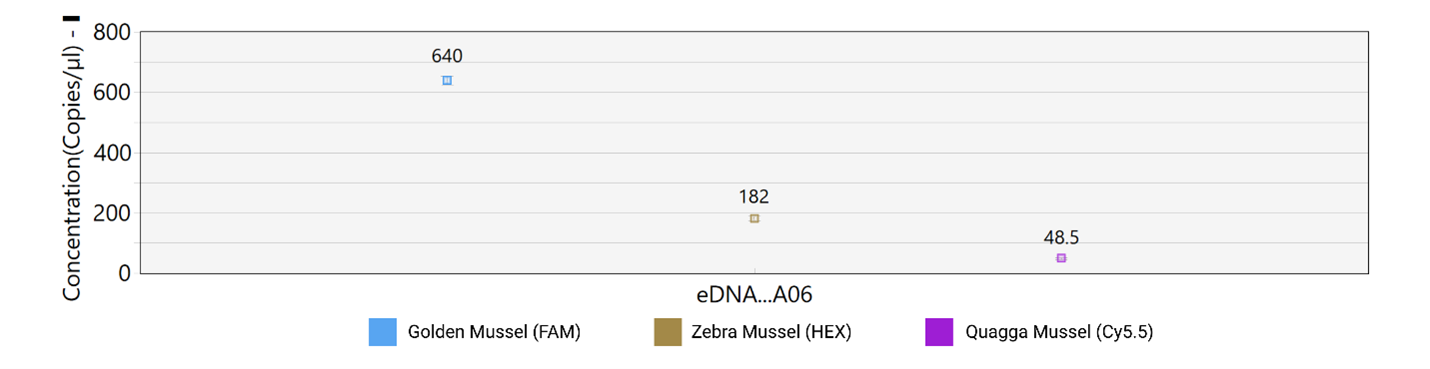

Figure 1: Copies per microliter of target DNA in a sample. This panel is a multiplex that includes Golden Mussel, Zebra Mussel, and Quagga Mussel.
Want to learn more about our eDNA capabilities?
eDNA allows us to better understand ecosystems—over time, across locations, and without intrusive methods. Combined with digital PCR, eDNA becomes a precise, powerful tool for modern environmental monitoring.
Be sure to check our resources page for the full list of on-hand eDNA assays. Questions about eDNA, custom targets, or other dPCR applications? Don’t hesitate to reach out!